
How to meet the MD Food Waste Law (Updated) Reg.
Updated January 2025

What is the Maryland Food Waste Law?
COMAR 26.04.13 Food Residuals - Organics Recycling and Waste Diversion implement House Bill 264/Senate Bill 483 requires certain generators within 30 miles of a composting facility to either reduce, divert to food rescue organizations, farms for animal feed operations, or compost or anaerobically digest the residuals.
Why are food waste laws important?
According to the Maryland Department of Environment (MDE), 26% of the waste entering landfills is organic and only 18% of food waste generated is recycled. Organic waste drives the carbon footprint of landfills. Reducing food waste and increasing diversion improves business efficiency, reduces environmental impact, and can decrease food insecurity.
What is a food waste ban?
Several states have Food Waste Bans which restrict businesses from disposing organic/food waste into the landfill trash.
Maryland has joined the list of State Food Waste Laws with the passing of MD House Bill 264 in May 2021. COMAR 26.04.13 became effective in December 2022 with requirements being phased in on January 1, 2023 and January 1, 2024.
What businesses are impacted by the MD Food Waste Ban?
Any business, including schools, institutions, supermarkets, or food establishments outside of restaurants that generate at least 1 ton of organic waste (food scraps) each week and are within 30 miles of a composting or digestion facility, must divert waste from the landfill or incineration.
Additionally, businesses subject to the law are now required to complete an annual Business Recycling Report on or before March 1 each year, starting in 2024. Please note this report goes beyond just composting weights, requiring all general trash and any applicable recycling streams such as compost, cardboard, mixed recycling,
What you need:
- Name of your solid waste and recycling haulers
- Total tonnage (previous CY) of solid waste
- Tonnage and type of recyclables, and the processing site/facility name(s)
Some counties, such as Montgomery and Prince George's Counties are requiring additional information, including waste hauling container types, counts, and service frequencies.

What are food residuals?
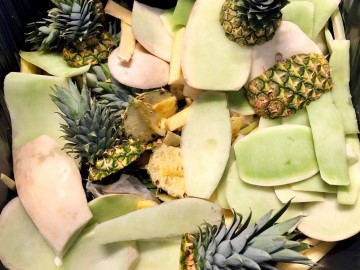
Food residuals is synonymous with organic waste. When exploring where to collect compost prioritize any biodegradable material that comes from a plant or an animal. Common items include:
• food preparation waste
• post-consumer food waste
• food production waste
• spoiled or expired food products
• yard trimmings, and
• BPI-certified compostable food packaging (plates, cups, and paper towels)
How much is 1 ton of food waste per week?

Food waste estimations are heavily dependent upon industry. MDE released Maryland Food Residual Generation Factor Estimates by Industry Sector which provides simple calculations for impacted industries A few examples include:
• Hotels with over 302 guest rooms occupied each week or 286 daily visitors.
• Event Spaces with 476 seats or 4,443 visitors each week.
• Hospitals with 84 acute care beds occupied each week.
• Assisted Living Complexes with 159 beds occupied each week.
• Office Buildings and Corporate Cafeterias with 3,200 meals served each week.
• Colleges & Universities with 5,713 meals served each week.
Other industries include, but are not limited to, manufacturing, supermarkets, wholesale operations, military installations, correctional facilities, and primary/secondary schools.
Where are the compost or anaerobic digestion facilities in Maryland?

Where are the compost or anaerobic digestion facilities in Maryland?
As of January 2025, according to MDE, Maryland had 6 permitted facilities for compost and 1 anaerobic digestor, with many others in surrounding states. Use the interactive map to view the 30-mile radius buffers.
Take a quick look at how many permitted organics recycling facilities operate in and around Maryland. Chances are, your organization is within a 30-mile service radius of one.
The MDE maintains an interactive map showing permitted composting and organics recycling facilities across the state, including their service coverage areas. This tool makes it easy to identify nearby processing options and understand what infrastructure already exists to support food scrap diversion.
What resources will be provided by the Maryland Department of Environment to help businesses comply?

Here’s a quick list of helpful tools to ensure compliance with the law:
Need Some Help?
Are you overwhelmed with all the regulatory and compliance elements for the Maryland Food Waste Law?
Our team of exeperts are here to help answer questions and can help with an audit, and much more.
Contact us.
Ready to find out more?
Want to talk to our team about waste stream management?
Don't hesitate to get in touch with us to start the conversation.