
Everyone at the Table: Takeaways from Maryland’s 2026 Food Summit
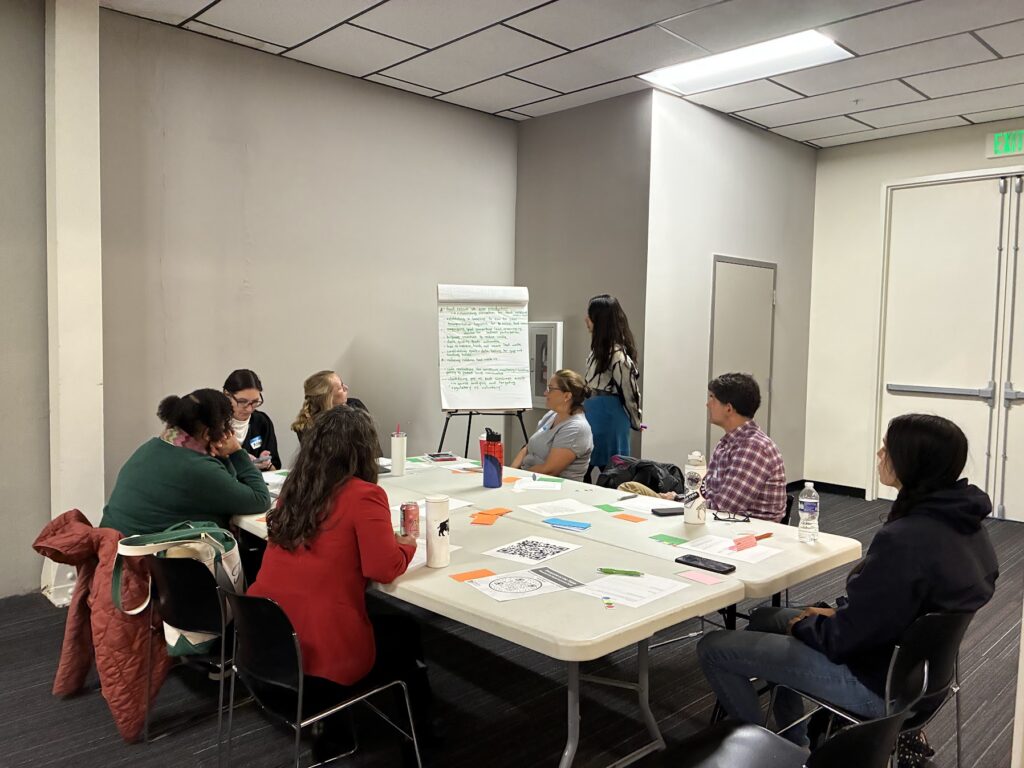
The Maryland Department of the Environment’s (MDE) 2026 Maryland Food Summit, “Everyone at the Table: Participate. Connect. Nourish. Create.” wasn’t your typical conference. True to its name, the summit was designed around participation, rather than sitting through a day of traditional panels and presentations. The roughly 200 attendees joined one of 20 working groups, each focused on a specific issue or opportunity within Maryland’s food system. The format created space to dig into challenges, share ideas and, most importantly, start thinking about what action could look like beyond the summit.
The summit builds on the state’s ongoing work around food residual diversion, waste infrastructure and a more resilient food system. It also came at an especially fitting time, in support of National Food Waste Prevention Week. Our team served as facilitator for one of the working groups, the “Spirulina Squad,” focused on food rescue, source reduction, climate emissions reductions – what’s the data and how to track.
For our team, the day was less about any single solution and more about the connections between them: better data, better infrastructure, better information and stronger regional networks.
Better data can lead to better food rescue.
Our group’s discussion focused on improving food-waste data standards and developing new tools that can help us understand where opportunities exist.
One particularly interesting concept was mapping cold food storage capacity. Cold storage is a critical piece of the food-rescue puzzle. When equipped with the knowledge and availability of refrigerated or frozen space it makes a huge impact to more easily move food to people instead of it going to waste.
Build the system around connection.
Many group conversations pointed toward the value of local and regional hubs: connecting food production, storage, transportation, rescue and end markets.
That same thinking applies to information. There was strong interest in centralizing resources, potentially by region, so organizations can more easily find tools, guides, information and solution providers instead of navigating a patchwork of disconnected resources.
Small details can have big impacts.
There was a lot of discussion about food labeling and food donation protections.
Clearer understanding of “Sell By” versus “Use By” dates can help prevent edible food from being discarded unnecessarily.
There is the all too common “but we could be sued” mentality when it comes to food rescue or donation. There are protections in place for food donation, including the Bill Emerson Good Samaritan Food Donation Act and newer federal protections added in 2022 (Federal Liability Protections – ReFED). Understanding what those protections cover can make food donation feel much less complicated and help remove a barrier that may be standing in the way of food rescue. Check out MDE’s Food Donation Guide for more hands-on and regional focused information.
Composting: Learning from Mother Nature.
Another takeaway that stuck with us was the idea that composting is ultimately about working with nature, not simply managing waste. Nature doesn’t “throw away” nutrients. It continually cycles organic material back into the system.
Food scraps still have value after they leave the plate. Returning their organic matter and nutrients to the soil through composting and other recovery methods helps close the loop and build a more circular system.
There are strong headwinds – but there’s A LOT worth fighting for.
The challenges are real. Food waste sits at the intersection of infrastructure, economics, transportation, policy, behavior and access. Changing any one piece is rarely simple.
But walking away from the summit, we were reminded that we’re not tackling these challenges alone. There is a strong and growing community of people across Maryland who care deeply about these issues and are willing to keep working together toward solutions.
The work ahead will require better data, stronger connections, practical tools and a willingness to rethink systems that have been in place for decades. It will require everyone at the table.
A big thank you to MDE Food Summit Team for bringing this community together, continuing the conversation and creating space for people across the food system to connect, learn and keep pushing forward. We’re grateful to be part of the conversation and look forward to continuing to support this work.

Our team of sustainability and waste consultants work together to develop content for our site. Contact us to learn more about something we’ve written about or would like us to focus on in the future.
Newsletter
Keep up to date with the latest from the Reduction In Motion team.